Overview
Essentially every massive galaxy hosts a central black hole, yet the origin of these objects remains one of the central open problems in astrophysics. Three families of seeding channels are usually considered: light seeds of order 102 M☉ left behind by the first generation of metal-free stars, heavy seeds of 104–105 M☉ produced by the direct collapse of pristine gas clouds, and intermediate seeds built by runaway stellar and stellar-remnant mergers in the dense cores of young clusters. Each scenario predicts a distinct black hole occupation fraction and mass distribution in low-mass galaxies today, and each is subsequently reshaped by gas accretion and by galaxy–galaxy mergers. The existence of billion-solar-mass quasars already at z > 6 demands extremely rapid early growth, while the black holes in nearby dwarf galaxies and star clusters are the least-evolved relics available and therefore retain the clearest memory of the seeds themselves.
Supermassive Black Holes & Host Galaxies Correlations
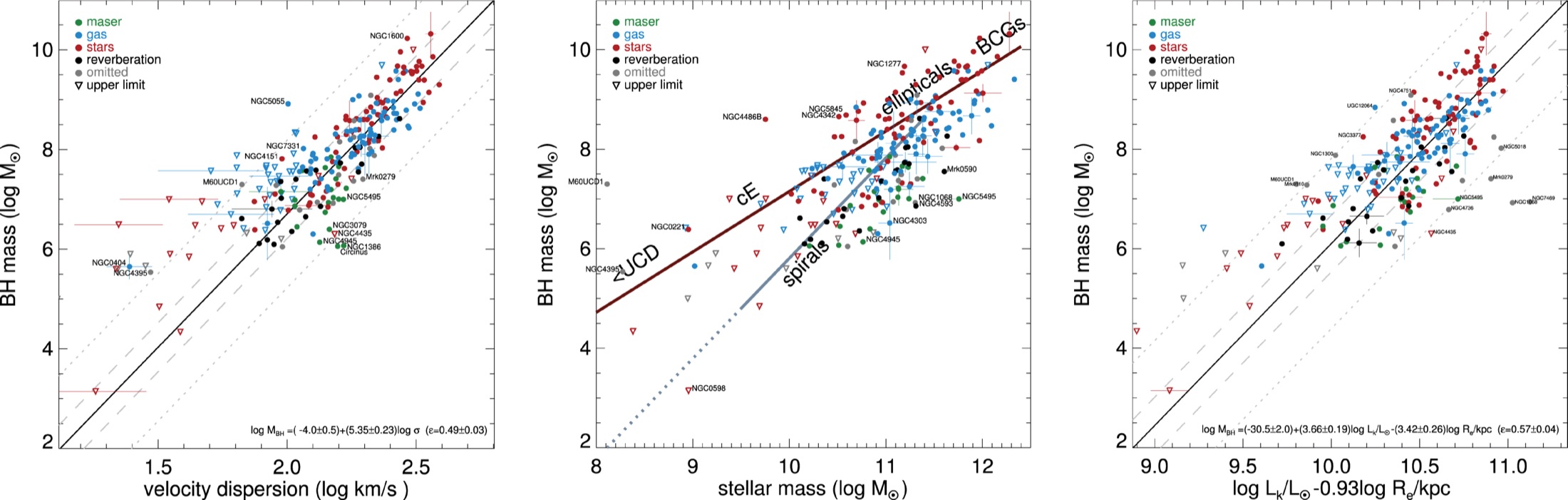
The modern picture began when dynamical surveys of nearby galaxies revealed that black-hole mass correlates tightly with properties of the surrounding stellar bulge. Magorrian et al. (1998) established the link to bulge mass, and within two years the remarkably tight relation with stellar velocity dispersion; the $M_{\rm BH}-\sigma$ relation was reported independently by Ferrarese & Merritt (2000) and Gebhardt et al. (2000).
The small scatter of these relations — and of related combinations of host luminosity and effective radius that behave like a black-hole fundamental plane — implies that black holes and their hosts are not independent, but grow in concert. Reviews by Gültekin et al. (2009) and Kormendy & Ho (2013) consolidated the census and refined the slopes, while raising a question that still drives the field: what physical mechanism keeps a black hole and a galaxy — separated by more than nine orders of magnitude in scale — so closely coupled?
My Research
My work attacks this problem from the observational side by building homogeneous, dynamically measured black hole masses across the whole accessible mass range. Using JWST/NIRSpec and NIRCam data, ALMA molecular-gas observations, and end-to-end simulations of ELT instruments, I measure masses in systems from dwarf galaxies and nuclear star clusters up to giant ellipticals, so that the low-mass end of the local mass function — the regime that discriminates most strongly between seeding channels — can be populated with reliable measurements rather than upper limits.
Literature Review
At the low-mass end, the seeds of today's black holes are unknown: did they form as light remnants of the first stars or as heavy direct-collapse objects (Volonteri 2010)? The occupation fraction of intermediate-mass black holes in dwarf galaxies — a direct discriminator between these channels — is still poorly constrained (Greene, Strader & Ho 2020; Reines & Volonteri 2015).
Summary of Findings
A summary of key results and findings for this theme is in preparation and will be added here.